
Hybrid Contact Lenses in Michigan
A hybrid contact lens is one lens with two materials: a rigid gas permeable centre bonded to a soft skirt around the edge. The rigid centre does the optical work over your cornea. The soft skirt rests on the surrounding eye, holds the lens centred, and means your eyelid crosses a soft edge with every blink rather than a hard one.
That combination exists to solve one specific, common problem: some eyes need rigid optics but cannot tolerate a rigid lens.
Why a hybrid, and not a soft lens
A soft lens drapes over whatever shape your cornea happens to be. If that shape is regular, it works well. If the cornea is irregular — keratoconus, scarring, a transplant, post-surgical change — the soft lens takes up the irregularity and passes it straight through to your vision. You get comfort without clarity.
A rigid lens does the opposite. It holds its own shape, and the thin layer of tears between lens and cornea fills in the irregularity, so light reaches your retina through a smooth optical surface. That is why RGP lenses give sharper vision on an irregular cornea than any soft lens can.
The trade-off has always been comfort. A corneal RGP is small and its edge sits on the cornea, which is the most densely nerve-supplied tissue in the body. Plenty of people adapt to it. Plenty of others never do.
A hybrid keeps the rigid optics and moves the edge off the cornea onto the soft skirt. You get the vision of a rigid lens with a feel much closer to a soft one.
Who hybrid lenses suit
Keratoconus and irregular corneas
For mild to moderate keratoconus, a hybrid is often a very good answer. The rigid centre masks the cone and restores the sharpness that glasses and soft lenses cannot reach, and the soft skirt keeps the lens centred over a shape that would push a corneal RGP off-centre.
Where hybrids become the wrong tool is in advanced keratoconus, or when the cone is very steep or sits well away from the centre of the cornea. At that point the lens struggles to stay stable and scleral lenses usually give a better result — see the comparison below.
Astigmatism that soft lenses never quite fix
This is the group most likely to have been told nothing is wrong, and most likely to be frustrated.
A soft toric lens corrects astigmatism only while it stays rotationally oriented on your eye. Blink, rub, or look sharply to one side and it can shift. For some people that shift is small and unnoticeable. For others it means vision that is crisp for a moment and then is not — and no amount of changing soft toric brands fixes it, because the mechanism is the problem.
A hybrid’s rigid centre corrects astigmatism through the tear layer instead of depending on lens orientation. The vision holds steady. If you have been through several toric soft lenses without getting stable vision, this is worth asking about — as are rigid gas permeable lenses for astigmatism, which work the same way in a smaller lens.
People who could not wear RGPs
If you were fitted with corneal RGPs and gave up on them, that history does not rule out rigid optics — it rules out that lens design. A hybrid, or a scleral, moves the edge off the cornea entirely. Being hard to fit is usually a statement about which lenses have been tried, not about your eyes.
Post-surgical corneas
After LASIK, PRK or RK, or with post-surgical ectasia, the cornea can be smooth enough to reject a soft lens optically but regular enough that a hybrid manages it well. Which of hybrid or scleral suits depends on how much irregularity there is and where.
The hybrid lens designs
Hybrid lenses in the United States come from SynergEyes, who developed the bonding technology that makes a rigid-to-soft join reliable. The designs you will come across:
- Duette — for regular corneas, astigmatism and presbyopia. This is the design used when the goal is better optics than a soft lens rather than managing corneal disease. A multifocal version exists.
- UltraHealth — for keratoconus and irregular corneas. It vaults higher over the cornea than Duette, which is what lets it clear a cone.
- ClearKone — the earlier generation of the irregular-cornea design, and still the name many patients know. UltraHealth superseded it.
- SoftPerm — a much older hybrid that predates current materials. You may see it referenced in older material; it is not comparable to what is fitted now.
Which design fits your eye is a clinical decision taken from your corneal map, not a matter of preference or brand loyalty. The right answer for a moderate central cone is different from the right answer for astigmatism on an otherwise healthy cornea.
A note on “piggyback” fitting. You may also encounter a piggyback arrangement — a rigid lens worn on top of a soft one, achieving something similar with two separate lenses. It still has a place in specific cases, but a purpose-built hybrid is generally simpler to wear and to care for than managing two lenses.
Hybrid, scleral or RGP?
All three give rigid optics. They differ in where the lens lands.
| Hybrid | Scleral | Corneal RGP | |
|---|---|---|---|
| Size | Larger than an RGP | Largest | Smallest |
| Where it rests | Soft skirt on the surrounding eye | Entirely on the white of the eye | On the cornea |
| Clears the cornea? | Rigid centre sits close over it | Vaults fully clear, saline reservoir beneath | Rests directly on it |
| Best for | Mild to moderate irregularity, astigmatism, RGP intolerance | Advanced irregularity, severe dry eye, transplants | Regular to moderately irregular corneas, in adapted wearers |
| Comfort | Close to a soft lens at the edge | Very good — nothing touches the cornea | Most demanding to adapt to |
| Dry eye | Neutral | Best option, because of the fluid reservoir | Can worsen it |
| Handling | Straightforward | Needs filling with saline each time | Simplest |
The honest summary: hybrids are often the right answer for milder irregularity and for astigmatism that soft lenses cannot stabilise. Sclerals win as irregularity or dryness becomes more severe. We fit both, which means the recommendation can follow your cornea rather than what a practice happens to offer.
What a hybrid fitting involves
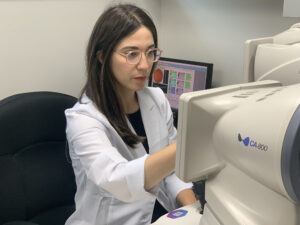
Corneal mapping first. We map the shape of your cornea before selecting a design — see our technology. Choosing a hybrid design without knowing how steep the cornea is and where its apex sits is guesswork.
Diagnostic lenses. You will usually try lenses at the consultation, so you can see what your vision could be before committing to anything.
The lens is ordered to your eye, then fitted and assessed on the eye when it arrives.
Handling training. Hybrids insert and remove differently from soft lenses, and the technique matters — a hybrid handled roughly can separate at the bond. Nobody leaves without practising it here.
Follow-up and refinement. Parameters often need adjusting once or twice before the fit is right. That is normal, and it is included.
Caring for hybrid lenses
Hybrids need care appropriate to a rigid lens, not a soft one. Use only the solutions we recommend — some soft lens multipurpose solutions are not suitable for the rigid centre or the bond. Never use tap water. Replace your case on schedule.
Handled properly, hybrids last considerably longer than disposable soft lenses, though the soft skirt does age and the lens is replaced periodically.
What hybrid lenses cost
There is no single price, because a hybrid fitting is a clinical process rather than a product. What you are paying for is the corneal mapping, the design selection, the diagnostic fitting, the lenses, handling training, and the follow-up visits and refinements.
Michigan Contact Lens is out-of-network by choice, which means the clinical decision is Dr. Kresch’s and yours rather than a plan’s. We provide a detailed superbill you can submit for out-of-network reimbursement, and we accept HSA and FSA funds, CareCredit, and in-house payment plans. See Insurance & Payment Options.
Hybrid contact lens fitting in Southfield and Metro Detroit
Dr. Shira Kresch, OD, MS, FAAO fits hybrid, scleral and rigid gas permeable lenses at Michigan Contact Lens in Southfield — serving Birmingham, Royal Oak, Troy, Farmington Hills, West Bloomfield, Novi, Oak Park, Huntington Woods, Rochester Hills and Detroit.
Because we fit the full range, the recommendation follows your cornea. If a hybrid is the best answer for your eye, that is what we will say. If a scleral would serve you better, we will say that instead.
No referral is needed, and your initial specialty consultation is complimentary.
Struggling with lenses that are either comfortable or clear, but never both?
That is precisely the problem hybrids were designed to solve. Bring your history and your current lenses — we will map your corneas and tell you honestly which design suits your eyes.
Hybrid Contact Lens Questions
- What are hybrid contact lenses?
A hybrid contact lens has a rigid gas permeable centre bonded to a soft skirt around its edge. The rigid centre sits over your cornea and does the optical work, giving the sharpness of an RGP lens. The soft skirt rests on the surrounding eye and holds the lens centred and stable, so it feels much closer to a soft lens than a rigid one. It is a single lens, not two lenses stacked.
- Are hybrid lenses good for keratoconus?
They can be an excellent option for mild to moderate keratoconus. The rigid centre masks the irregular corneal surface and restores sharp vision in a way soft lenses cannot, while the soft skirt avoids the lens-awareness that makes some patients unable to tolerate a corneal RGP. For advanced keratoconus, or where the cone is very steep or decentred, scleral lenses usually give a more stable result.
- What is the difference between hybrid and scleral lenses?
Both give RGP-quality vision with good comfort, but they achieve it differently. A hybrid lens has a rigid centre resting over the cornea within a soft skirt. A scleral lens is entirely rigid and larger, vaulting clear of the cornea altogether and landing on the white of the eye, with a reservoir of saline underneath. Sclerals handle more extreme irregularity and are better for severe dry eye because of that fluid reservoir. Hybrids are often simpler for milder irregularity and for people who want something closer to a soft-lens feel.
- Are hybrid contact lenses comfortable?
Most wearers find them substantially more comfortable than a corneal RGP, because the lens edge — the part your eyelid actually crosses with every blink — is soft. That is the whole design rationale. They are not entirely sensation-free, and there is usually a short adaptation period, but hybrids are commonly the answer for someone who needed rigid optics and could not tolerate a rigid lens.
- Can hybrid lenses correct astigmatism?
Yes, and they are often better at it than soft toric lenses. A soft toric has to stay rotationally oriented on the eye to work, and it can shift with a blink, which is why some people with astigmatism never get stable vision from soft lenses. A hybrid's rigid centre corrects the astigmatism optically through the tear layer rather than depending on lens orientation, so the vision holds steady.
- How much do hybrid contact lenses cost?
There is no single price, because a hybrid fitting is a clinical process rather than a product: corneal mapping, the lens selection and design, the fitting visits, handling training, and follow-up. Michigan Contact Lens is out-of-network by choice and provides a detailed superbill you can submit for out-of-network reimbursement. HSA and FSA funds, CareCredit and in-house payment plans are accepted, and your initial consultation is complimentary.
Ready to see clearly again?
Michigan Contact Lens fits scleral and specialty lenses for keratoconus, irregular corneas, corneal transplants, and severe dry eye.