
Scleral Lenses for Irregular Corneas After LASIK or PRK
LASIK and PRK give most people excellent vision. But a small number of patients end up with blurry, ghosted, or glare-filled vision that glasses and soft lenses can’t fully fix — often because the surgery left the cornea slightly irregular. If that’s you, scleral lenses are one of the most effective non-surgical solutions available.
Why vision can be off after refractive surgery
Even a technically successful procedure can leave the corneal surface a little uneven. Common reasons include irregular astigmatism, a decentered treatment zone, higher-order aberrations that cause halos and starbursts at night, post-surgical dry eye, and — in rare cases — corneal ectasia, a progressive thinning and bulging that resembles keratoconus. Any of these can blur vision in ways a standard lens simply can’t smooth out.
How scleral lenses fix post-surgical vision
A scleral lens vaults completely over the cornea and rests on the white of the eye, replacing your irregular surface with one flawless optical curve. Because vision is then formed by the smooth front of the lens rather than your uneven cornea, the irregular astigmatism and many higher-order aberrations are effectively neutralized. The saline reservoir held under the lens also soothes the post-LASIK dryness that troubles so many patients. There’s a fuller overview on our scleral lenses page.
Scleral lenses for post-LASIK ectasia
Post-refractive ectasia behaves much like keratoconus, and it’s treated similarly: the underlying thinning may be stabilized medically (for example with corneal cross-linking, managed by your surgeon or cornea specialist), while scleral lenses restore the day-to-day vision. The two approaches work together — one protects the cornea’s structure, the other gives you something to see with.
Are you a candidate?
If you’ve been told your post-surgical cornea is “irregular,” or you simply can’t get crisp vision no matter the glasses prescription, you’re likely worth evaluating. Start with who is a good candidate for scleral lenses, and see how they stack up against smaller lenses in scleral lenses vs. RGP lenses.
What the process looks like
Fitting begins with detailed corneal mapping, then trial lenses to dial in the vault and vision, followed by training and follow-ups. We walk through it in what to expect at a scleral lens fitting.
Will I need them forever?
That depends on your cornea. Some patients use sclerals only until their eyes are addressed surgically; others find them the best long-term option for sharp, comfortable vision. Either way, they’re non-invasive and fully reversible — you can stop at any time.
Frustrated with your vision after LASIK or PRK?
Dr. Shira Kresch offers complimentary specialty consultations at Michigan Contact Lens in Southfield, serving patients across Metro Detroit. We’ll map your corneas and tell you honestly whether scleral lenses are right for you.
Related reading
What Happens After You Refer A Patient | Michigan Contact Lens
For referring doctors: the specialty lens pathway step by step — what we do at each visit, what your patient is told, and exactly what comes back to you.

How Many Corneal Transplants Can You Have? | Michigan Contact Lens
Repeat corneal transplants are possible, but each one is a harder ask than the last. When a regraft is needed — and when a lens over the graft is the better answer.

Why Soft Lenses Fail On An Irregular Cornea | Michigan Contact Lens
A soft lens drapes over the cornea and reproduces its shape. On an irregular cornea that is the whole problem — and no amount of refitting changes it.
Finding A Scleral Lens Specialist In Metro Detroit
Looking for a scleral lens specialist near Detroit? What to look for, the conditions we treat, and how to book a free consultation in Southfield, MI.
Vision After A Corneal Transplant | Scleral Lenses
Blurry vision after a corneal transplant is normal, not a failure. Why it happens, the graft types, rejection warning signs, and how scleral lenses correct it.
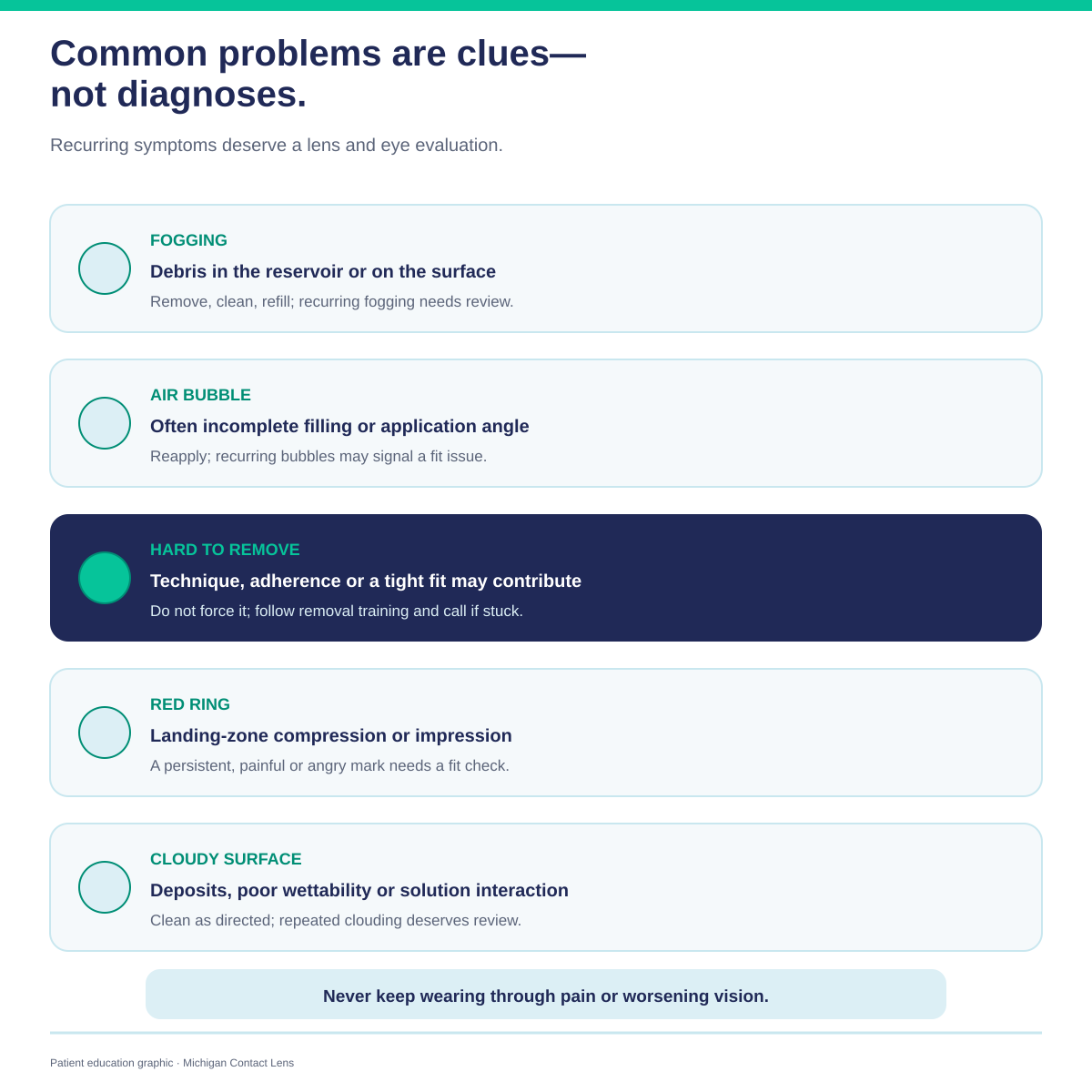
Do Scleral Lenses Hurt? Comfort And Adapting | MCL
A correctly fitted scleral lens should not hurt. What adaptation actually feels like, what discomfort usually turns out to be, and when to call.
Ready to see clearly again?
Michigan Contact Lens fits scleral and specialty lenses for keratoconus, irregular corneas, corneal transplants, and severe dry eye.