
How Much Do Scleral Lenses Cost? 7 Factors That Actually Determine the Price
If you’ve started researching scleral lenses, you’ve probably noticed something frustrating: almost nobody will tell you what they cost. That’s not because practices are hiding the number — it’s because scleral lenses aren’t a product with a sticker price. They’re a medical fitting process, and the cost depends on your eyes, your condition, and how the lenses are designed and fitted.
So instead of dodging the question, let’s answer it properly: here are the seven factors that actually determine how much scleral lenses cost, and how to make sure whatever you invest actually results in lenses you can see with and wear comfortably.
The short answer: why there’s no single price
How much do scleral lenses cost? It varies — because what you’re paying for isn’t just two lenses. A proper scleral lens fitting includes advanced diagnostic mapping, custom lens design, multiple fitting and refinement visits, and follow-up care. Two patients with different corneas can have genuinely different costs, even at the same practice.
At Michigan Contact Lens, your specialty consultation is free, and the exact investment for your eyes is explained up front — before you commit to anything. Here’s what goes into that number.
1. The condition being treated
A scleral lens fitting for early keratoconus is a different undertaking than fitting an eye after a corneal transplant, radial keratotomy, or years of severe dry eye. More irregular corneas demand more precise design work, more refinement, and more chair time. The complexity of your eyes is the single biggest driver of cost — which is also why a quote given over the phone, sight unseen, doesn’t mean much.
2. Custom-designed vs. fit-from-stock lenses
Some practices fit scleral lenses by trial and error from a standard fitting set. Others — including ours — design lenses from a precise 3D map of your eye using Eaglet Eye profilometry. A profilometry-designed lens is built for your eye’s exact geometry, including the sclera where the lens actually rests.
Custom design can affect the upfront cost — but it dramatically changes the odds that your first lenses are the right lenses, instead of the first attempt in a long series of remakes.
3. What the fitting process includes
When you compare costs between practices, you’re rarely comparing the same thing. Ask what’s actually included:
- How many fitting and refinement visits?
- Is diagnostic imaging (topography, profilometry) included or billed separately?
- Are lens remakes during the fitting period included?
- What happens if the first design doesn’t work?
A lower number that covers less is not a lower price — it’s a different product.
4. Lens material and design complexity
Scleral lenses come in different diameters, materials, and design architectures — from relatively standard designs to highly customized lenses with features like toric peripheries or front-surface customization for higher-order aberrations. Your prescription and corneal shape determine what your eyes need, and more complex designs involve more engineering.
5. The guarantee behind the fit
Here’s a question worth asking any practice: what happens if the lenses don’t work? Every specialty fitting at Michigan Contact Lens is backed by our Risk-Free Fit Guarantee — if we can’t achieve a comfortable, effective fit, you’re protected. A fitting fee that includes that protection is a fundamentally different investment than one where every adjustment starts the meter again.
6. Insurance reimbursement changes your real cost
Many patients assume specialty lenses are entirely out of pocket — and that’s often wrong. Many medical insurance plans reimburse a portion of medically necessary scleral lens care for conditions like keratoconus, post-surgical corneas, and severe ocular surface disease, even at an out-of-network practice.
After your visit, we provide a detailed superbill with every diagnosis and procedure code your insurer needs. You submit it, and reimbursement comes back to you based on your plan’s out-of-network benefits. Your real cost is the number after that reimbursement — not the number on the invoice. We break down exactly how this works on our Insurance & Payment Options page.
7. How you pay
The final factor isn’t the total — it’s the structure. We accept HSA/FSA funds (scleral lenses and specialty exams are qualified medical expenses for most plans), CareCredit financing, all major credit cards, check, and cash. And Medicaid patients can ask about our need-based program — qualifying patients receive up to 50% off their specialty care.
Why the cheapest fit is often the most expensive
Ask anyone who’s been through it: the most expensive scleral lenses are the ones sitting in a drawer. A bargain fitting that produces lenses you can’t wear costs you the full fee, the months of frustration, and then the cost of doing it all over again somewhere else — which is how many of our patients found us.
The goal isn’t the lowest invoice. It’s clear, comfortable vision from lenses you actually wear, fitted right the first time by a doctor who specializes in complex corneas.
Get your exact answer — free
The honest answer to “how much do scleral lenses cost” is: let’s look at your eyes and tell you precisely. Your specialty consultation at Michigan Contact Lens is free, with no commitment. You’ll leave knowing what’s going on with your eyes, what we’d recommend, and exactly what it would cost — including how superbill reimbursement and payment options apply to you.
Book your free specialty consultation or call (248) 545-2800. We’re at 17000 W 10 Mile Rd in Southfield, serving all of Metro Detroit.
Related reading
What Happens After You Refer A Patient | Michigan Contact Lens
For referring doctors: the specialty lens pathway step by step — what we do at each visit, what your patient is told, and exactly what comes back to you.

How Many Corneal Transplants Can You Have? | Michigan Contact Lens
Repeat corneal transplants are possible, but each one is a harder ask than the last. When a regraft is needed — and when a lens over the graft is the better answer.

Why Soft Lenses Fail On An Irregular Cornea | Michigan Contact Lens
A soft lens drapes over the cornea and reproduces its shape. On an irregular cornea that is the whole problem — and no amount of refitting changes it.
Finding A Scleral Lens Specialist In Metro Detroit
Looking for a scleral lens specialist near Detroit? What to look for, the conditions we treat, and how to book a free consultation in Southfield, MI.
Vision After A Corneal Transplant | Scleral Lenses
Blurry vision after a corneal transplant is normal, not a failure. Why it happens, the graft types, rejection warning signs, and how scleral lenses correct it.
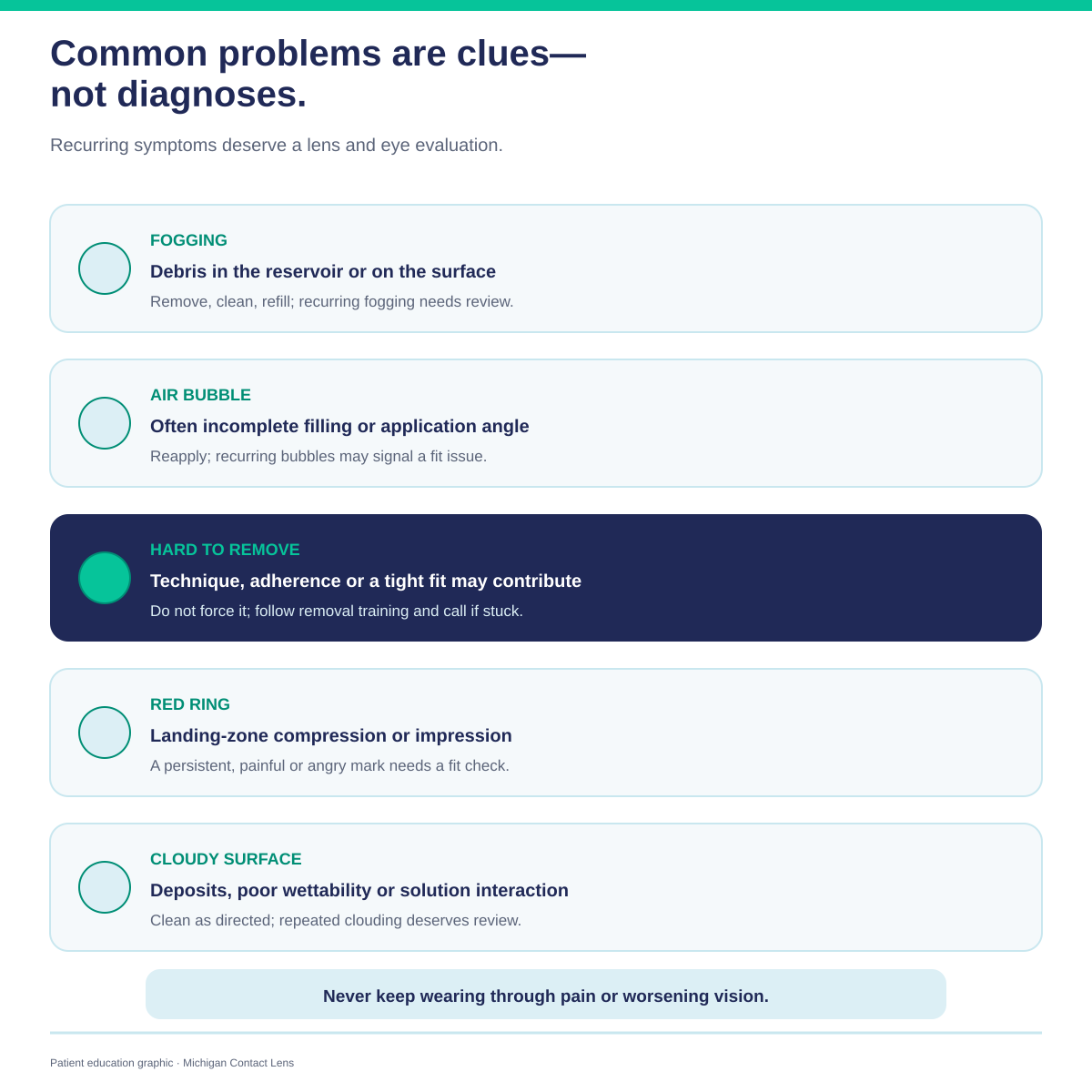
Do Scleral Lenses Hurt? Comfort And Adapting | MCL
A correctly fitted scleral lens should not hurt. What adaptation actually feels like, what discomfort usually turns out to be, and when to call.
Ready to see clearly again?
Michigan Contact Lens fits scleral and specialty lenses for keratoconus, irregular corneas, corneal transplants, and severe dry eye.