Getting a keratoconus diagnosis raises two questions almost immediately: what can be done? and what will it cost? The first has a genuinely hopeful answer. The second is harder to pin down — not because anyone is hiding numbers, but because keratoconus treatment cost depends entirely on which path your eyes need, how advanced your condition is, and what’s actually included in the care you’re comparing.
Here’s an honest breakdown of what determines the cost of keratoconus treatment, so you can evaluate your options clearly.
The short answer: two different cost conversations
Keratoconus treatment cost varies because “treatment” really means two different things: stabilizing the cornea (slowing or halting progression) and restoring your vision (correcting what the irregular cornea does to your sight). Most patients end up needing a plan that addresses both — and each has its own cost structure.
At Michigan Contact Lens, your specialty consultation is free, and we map out your full treatment picture — including costs — before you commit to anything.
1. How advanced your keratoconus is
Early keratoconus may be managed with simpler corrections and careful monitoring. More advanced cones, significant thinning, or corneal scarring demand more sophisticated lens designs and more fitting expertise. The stage of your condition is the single biggest cost driver — and another reason an early, accurate diagnosis pays for itself.
2. The vision-correction path your eyes need
Vision correction for keratoconus spans a wide range, and each option carries a different investment:
- Glasses and standard soft lenses — least expensive, but they typically stop working as the cornea becomes more irregular.
- Rigid gas permeable (RGP) lenses — a long-standing keratoconus option with moderate cost.
- Hybrid lenses — RGP optics with a soft skirt, a middle path for some corneas.
- Scleral lenses — the gold standard for many irregular corneas, vaulting over the cone entirely. Because they’re custom medical devices fitted through a multi-visit process, they’re also the most significant investment. We covered exactly what drives that number in How Much Do Scleral Lenses Cost?
3. Whether your cornea needs stabilizing
If your keratoconus is progressing, your doctor may recommend corneal cross-linking (CXL) — a procedure performed by a corneal surgeon that strengthens the cornea to slow or halt progression. That’s a separate cost conversation with the surgical practice, and insurance often treats medically necessary cross-linking differently than it treats lenses.
We work closely with corneal surgeons across Michigan and co-manage care before and after cross-linking — so your monitoring, your lens plan, and your surgical care stay coordinated instead of fragmented.
4. Custom design vs. trial-and-error fitting
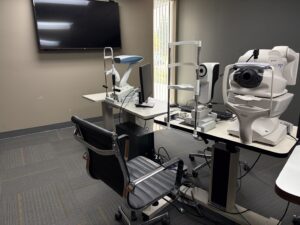
For specialty lenses, how they’re designed matters as much as which type you choose. Lenses designed from a precise 3D map of your eye — using Eaglet Eye profilometry — are built for your exact corneal geometry. That precision affects cost, but it dramatically improves the odds that your first lenses are the right ones, instead of a frustrating series of remakes.
5. What the fitting actually includes
Two quotes are only comparable if they cover the same things. Ask: how many visits are included? Is diagnostic imaging billed separately? Are remakes covered during fitting? Is there a guarantee? Every specialty fitting at Michigan Contact Lens is backed by our Risk-Free Fit Guarantee — if we can’t achieve a comfortable, effective fit, you’re protected.
6. Insurance and your real cost
Keratoconus is a diagnosed medical condition — and that matters. Many medical insurance plans reimburse a portion of medically necessary specialty lens care for keratoconus through out-of-network benefits. After your visit, we provide a detailed superbill with every diagnosis and procedure code your insurer needs; you submit it and reimbursement comes back to you directly.
Your real cost is what remains after reimbursement — see our Insurance & Payment Options page for exactly how that works, along with HSA/FSA, CareCredit, and our Medicaid need-based program (up to 50% off for qualifying patients).
The cost of waiting
One more factor belongs in every keratoconus cost conversation: progression. Untreated, progressing keratoconus can mean more advanced (and more involved) treatment later. Catching it early, monitoring it properly, and acting at the right time is the cheapest version of this disease there is.
Get your exact numbers — free
The honest answer to “how much does keratoconus treatment cost” is: it depends on your cornea — so let’s look at it. Your specialty consultation with Dr. Shira Kresch is free, with no commitment. You’ll leave knowing your stage, your options, and your exact investment for each path — including how reimbursement applies to you.
Book your free specialty consultation or call (248) 545-2800. Have more questions first? Our Keratoconus FAQ covers the most common ones.
Related: Explore your full range of keratoconus treatment in Michigan — from corneal cross-linking to custom specialty lenses.