
Michigan's Contact Lens Specialists
6-Step Scleral Lens Fitting in Birmingham MI
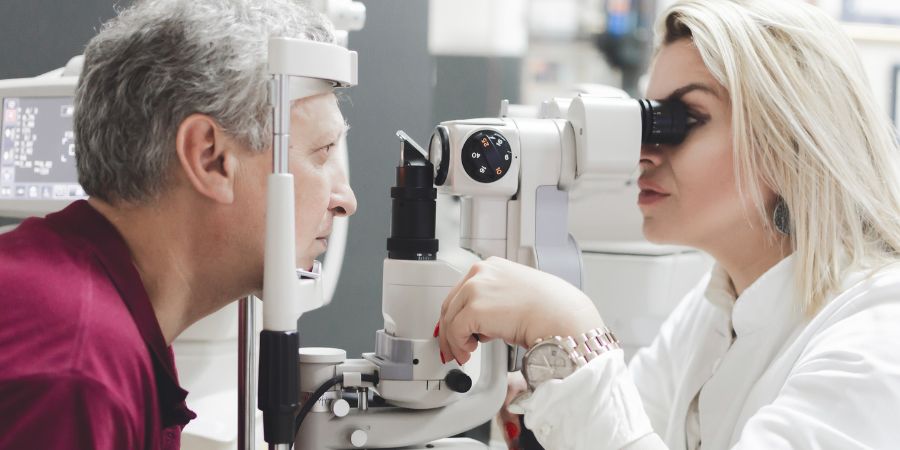
Patients in Birmingham MI looking for scleral lenses can benefit from advanced custom fittings at Michigan Contact Lens. We help manage keratoconus, dry eye, and irregular corneas with lenses designed for better clarity and long term comfort.If you’ve been told you have an “irregular cornea” or are “hard to fit” with contacts, there is an advanced solution that can truly change your life. That solution begins with a specialized, in-depth process: a scleral lens fitting in Birmingham MI.
Why a Scleral Lens Fitting is More Than a Standard Eye Exam
It’s important to understand the difference between a routine eye exam and a scleral lens fitting. A standard exam determines your prescription for glasses. A regular contact lens exam adds a few basic measurements to fit a conventional soft lens.
A scleral lens exam in Birmingham MI, however, is a far more detailed medical evaluation.
The “fitting” process encompasses the entire journey. It includes the initial comprehensive exam, advanced digital mapping of your eye’s surface, the hands-on process of trying diagnostic lenses, custom lens design, and multiple follow-up visits to perfect the fit.
Because scleral lenses are custom medical devices, this meticulous process is essential for ensuring safety, comfort, and optimal vision. A proper scleral lens fitting in Birmingham MI is a blend of medical science and skilled artistry, tailored to your unique eyes.
Who is an Ideal Candidate for Scleral Lenses?
A scleral lens fitting in Birmingham MI is recommended for individuals who cannot achieve clear or comfortable vision with other methods. This primarily includes patients with the following conditions:
Keratoconus & Corneal Ectasias
For patients with a cone-shaped or bulging cornea, glasses can’t correct the distortion and soft lenses simply drape over the irregular shape, failing to improve vision.
According to the National Keratoconus Foundation, finding a stable vision solution is the primary challenge for patients. Scleral lenses vault over the cone entirely, creating a perfectly smooth optical surface that provides crisp, clear sight.
If you are looking for a keratoconus doctor in Birmingham MI, finding an expert in scleral lenses is paramount.
Severe Dry Eye Syndrome
For those suffering from conditions like Sjögren’s Syndrome, Stevens-Johnson Syndrome, or Graft-vs-Host Disease, the eyes can be too dry and sensitive for any other type of lens.
As noted by the National Eye Institute, severe cases require more than just artificial tears. A scleral lens creates a fluid-filled reservoir over the cornea, acting as a “liquid bandage” that provides constant hydration, protection, and profound relief from pain.
Post-Surgical Complications
Vision problems can sometimes occur after procedures like LASIK, RK (Radial Keratotomy), or corneal transplants, resulting in a newly irregular eye surface. Scleral lenses are a non-surgical solution that can restore sharp vision by bypassing these irregularities.
High or Irregular Astigmatism
For some individuals, astigmatism is so complex that it cannot be fully corrected with glasses or soft toric lenses. Scleral lenses provide a stable, rigid surface that offers superior astigmatism correction and stable vision.
The Technology Behind a Perfect Scleral Lens Fitting
Achieving a truly custom fit requires more than just a standard eye chart. At our Birmingham clinic, we utilize state-of-the-art technology to gather incredibly precise data about your eyes.
Corneal Topography
This is the first and most critical step. A corneal topographer is a non-invasive imaging device that creates a detailed, 3D color map of your cornea’s surface. It shows us the exact size, shape, and steepness of any irregularities. This map acts as the blueprint for designing a lens that will perfectly vault over your cornea without touching it.
Scleral Profilometry / OCT Imaging
This is what sets a true specialist apart. The sclera—the white part of the eye where the lens rests—is not a perfect sphere. It has its own unique curves, bumps, and angles.
We use advanced technology like an Optical Coherence Tomography (OCT) scanner to map the shape of your sclera. This allows us to design a lens with edges that land evenly and comfortably on your eye, creating a stable, sealed fit that prevents lens movement and fogging.
The Art of Customization: Why Sclerals Are Not ‘One Size Fits All’
The complexity and effectiveness of scleral lenses come from their incredible range of customizable parameters. Unlike a soft lens, which has limited options, nearly every aspect of a scleral lens can be tailored to your specific eye.
This level of detail is what makes an expert scleral lens fitting in Birmingham MI so crucial. During the process, we consider:
Diameter and Vault
The overall size (diameter) and the height of the dome (vault) are the foundational parameters. A patient with a very steep keratoconic cone will require a much higher vault than a patient with a relatively flat post-LASIK cornea. We select the smallest possible diameter that is still large enough to land comfortably and provide a complete corneal vault.
Toric Landing Zones
Just as a cornea can have astigmatism (two different curves), the sclera can too. If a standard, symmetrical lens edge lands on an asymmetrical sclera, it can cause the lens to rock, decenter, or allow debris underneath. We can design the lens with toric peripheries, or landing zones, that match the unique curves of your sclera for a perfectly stable fit.
Multifocal and Astigmatism Correction
Modern scleral lenses can do more than just correct for the corneal irregularity. We can incorporate advanced optics onto the front surface of the lens to correct other issues. This includes adding multifocal optics for patients with presbyopia (difficulty reading up close) or correcting any residual astigmatism. The ability to add these optics is a game-changer, and it all starts with a precise scleral lens fitting in Birmingham MI.
Advanced Modifications
For truly unique eyes, we can even add specialized modifications like notches to accommodate growths on the sclera (like a pinguecula) or tiny fenestrations (holes) to help reduce suction on removal. Each of these advanced customizations is considered during a thorough scleral lens fitting in Birmingham MI.
What to Expect at a Scleral Lens Fitting: The Step-by-Step Process
The journey to your custom lenses is a precise, collaborative process. Here’s a detailed look at what happens during a scleral lens fitting in Birmingham MI at our clinic.
Step 1: The Initial Consultation
We begin by discussing your medical and ocular history, your previous experiences with vision correction, your daily lifestyle, and your ultimate visual goals. This conversation is key to tailoring the process to you.
Step 2: The Comprehensive Exam
Next comes the comprehensive scleral lens exam in Birmingham MI. This includes assessing your prescription and performing the advanced diagnostic imaging with the topographer and OCT scanner as described above.
Step 3: The Diagnostic (Trial) Lens Fitting
This is the hands-on part of the process. Based on your eye maps, we select several diagnostic lenses from our extensive trial set. We place a lens on your eye with fluorescein dye, which allows us to use a special blue light and microscope (a slit lamp) to see the fluid layer. We meticulously assess the lens’s central clearance, how it lands on your sclera, and how it moves, making micro-adjustments to find the most stable and comfortable starting point.
Step 4: Custom Lens Design and Ordering
Using the data from your exam, topography, and diagnostic fitting, we design your personalized scleral lenses. We specify numerous parameters—diameter, vault, edge design, material, and your exact prescription—and send this design to a specialized laboratory where your lenses are custom-manufactured.
Step 5: Dispensing and One-on-One Training
When your custom lenses arrive, we schedule a dispensing appointment. Our team will teach you proper, safe techniques for insertion, removal, cleaning, and disinfection. We ensure you are completely comfortable and confident before you take your new lenses home.
Step 6: Follow-Up Visits for Fine-Tuning
A perfect fit is a process. We will schedule follow-up appointments to assess your vision and comfort after several hours of wear. We may make small adjustments to the lens power or design as needed to guarantee your long-term success and happiness. This commitment to perfection is a core part of every scleral lens fitting in Birmingham MI.
Experience the Difference: Your Free Scleral Lens Trial
We understand that investing in a custom medical device is a big decision. For those considering scleral lenses, we offer a unique opportunity: a free scleral lens trial during your initial consultation.
This allows you to experience firsthand the remarkable comfort and clarity that scleral lenses can provide before committing to a full fitting or purchase.
During the free trial, our skilled optometrists will place a diagnostic lens on your eye, allowing you to gain valuable insight into how these lenses can improve your daily vision. It’s a risk-free way to explore this advanced option. This is a key part of our approach to every scleral lens consultation in Birmingham.
Your Expert Scleral Lens Fitting in Birmingham MI
Choosing to pursue scleral lenses is a significant step toward reclaiming your vision and quality of life. The success of this journey depends almost entirely on the skill and dedication of the practitioner performing the fitting.
It requires a deep understanding of ocular health, advanced technology, and a patient-centered approach. At Michigan Contact Lens, we are dedicated to providing the highest standard of care for every scleral lens fitting in Birmingham MI.
We are here to guide you through the entire process, from your first consultation to your successful long-term wear.
Ready to see the world with newfound clarity and comfort?
Contact Michigan contact lens today to schedule your comprehensive evaluation.
How The Michigan Contact Lens Specialists Can Help
Our specialists have years of experience fitting:
Have questions before booking? Call our eye specialists and we will talk it through.
Frequently Asked Questions About Scleral Lenses
- Are scleral lenses hard to put in and take out?
There is a learning curve because of their size, but it is very manageable — most patients are proficient within a week or two of daily practice. We train you one-on-one in the chair, provide the plungers that make handling straightforward, and you can come back for another handling lesson any time. See how to insert and remove scleral lenses.
- Can I swim in scleral lenses?
Don’t swim, shower or use a hot tub in any contact lens, sclerals included, unless your doctor has specifically cleared it. Water — including pool, tap and bottled water — can carry Acanthamoeba, which causes a corneal infection that is very difficult to treat. If you are going to be in the water, tight-fitting goggles are not optional.
- How long do scleral lenses last?
With proper care and handling, a pair of custom scleral lenses typically lasts one to three years before a remake is worth considering. Tear chemistry, handling and how much protein you deposit all affect it. See how long scleral lenses last and what drives the cost.
- Is the scleral lens fitting process covered by insurance?
Often partially, through out-of-network reimbursement. Scleral lenses are a medically necessary device for conditions like keratoconus rather than a cosmetic luxury, so they fall under medical plans rather than vision plans, and many medical plans reimburse a portion of that care. Michigan Contact Lens is out-of-network by choice, so we do not bill your insurer — after your visit you receive a detailed superbill carrying every diagnosis and procedure code your plan needs, you submit it, and reimbursement comes to you according to your out-of-network benefits. Our team shows you exactly how.
- Where can I get a scleral lens fitting near Birmingham, MI?
At Michigan Contact Lens in Southfield, a short drive from Birmingham. Dr. Shira Kresch, OD, MS, FAAO fits scleral lenses for keratoconus, irregular corneas, eyes after corneal transplant, and severe dry eye.
- How long does a scleral lens fitting take?
More than one visit. There is an initial specialty evaluation with corneal mapping, a diagnostic trial fitting, then a dispensing visit and follow-ups to fine-tune the design once you have worn the lenses in daily life. That sequence is what produces a lens still comfortable at hour twelve — see what to expect at a scleral lens fitting.
- Are scleral lenses good for keratoconus?
They are one of the primary options. A scleral lens vaults over the irregular cornea entirely and replaces it optically with a smooth front surface, which is why it can restore vision that glasses and soft lenses cannot. See scleral lenses for keratoconus.
- Do scleral lenses help dry eyes?
For many patients with severe dry eye, yes. The lens holds a reservoir of preservative-free saline against the cornea for the whole wearing day, so the ocular surface stays bathed rather than exposed. It treats the surface rather than the underlying cause, so it is often combined with other dry eye treatment — see scleral lenses for dry eyes.
- Who should fit scleral lenses?
Someone who fits them regularly. Scleral lens fitting is a specialty skill built on corneal mapping, scleral profilometry and a lot of case experience, and the fit is what determines whether you wear the lenses comfortably or abandon them. Dr. Kresch is an optometrist with a fellowship in the American Academy of Optometry (FAAO), and specialty lens fitting is the focus of the practice.