
Does Medicare Cover Scleral Lenses? What Patients Should Know
The short answer: usually not for the lenses themselves — with important exceptions. Original Medicare doesn’t cover routine contact lenses, and for most corneal conditions like keratoconus it generally won’t cover the scleral lens material either. The main exception is aphakic lenses (for an eye left without a natural or implanted lens after cataract surgery), which Medicare covers as a prosthetic. The lens fitting may still be separately billable, and Medicare Advantage plans set their own rules. Here’s how to find out where you actually stand.
How Medicare thinks about scleral lenses
Medicare draws a hard line between routine vision correction (not covered) and medically necessary treatment of an eye disease (potentially covered). Scleral lenses for keratoconus, corneal transplants, severe dry eye, or post-surgical irregular corneas sit on the medical side of that line — they’re treating a diagnosed condition, not just sharpening normal vision. Even so, Original Medicare’s contact-lens benefit is narrow: it covers lenses as a prosthetic mainly for aphakia (an eye without a natural or implanted lens), not for keratoconus itself. What is often billable is the medically necessary fitting service, and the documented diagnosis is what makes any reimbursement conversation — or a Medicare Advantage claim — possible. Our guide to what determines scleral lens cost explains the medical-fitting side of the equation.
Medicare Advantage is its own animal
Medicare Advantage (Part C) plans set their own rules, networks, and prior-authorization requirements, and many bundle vision benefits that original Medicare lacks. Two patients with “Medicare” can have completely different coverage realities. The only reliable answer comes from your specific plan — ask them directly whether medically necessary scleral lenses for your diagnosis code are reimbursable, and what documentation they require.
How it works at an out-of-network specialty practice
Michigan Contact Lens is out-of-network by choice — it’s what lets Dr. Kresch run every test your eyes need rather than what a plan allows. After your visit, we provide a detailed superbill: an itemized statement with every diagnosis and procedure code your insurer needs to process an out-of-network claim. You submit it to Medicare or your Advantage plan, and any reimbursement comes directly to you. HSA funds, CareCredit, and our payment plans also apply — the full picture is on our Insurance & Payment Options page.
What to ask before your fitting
Call the number on your Medicare or Advantage card and ask three questions: Does my plan reimburse medically necessary contact lenses for my diagnosis? Do you accept out-of-network claims with a superbill? Is prior authorization required? Bring the answers to your free consultation — we’ll walk through the rest together, and the investment for your care is explained up front before you commit to anything.
Bring your Medicare questions to your free specialty consultation — Dr. Shira Kresch serves patients across Metro Detroit from our Southfield office. Book online or call (248) 545-2800.
Frequently Asked Questions
- Does original Medicare pay for scleral lenses?
Generally not for the lenses themselves in conditions like keratoconus. Original Medicare covers contact lenses as a prosthetic mainly for aphakia (an eye without a natural or implanted lens after cataract surgery). The medically necessary fitting service may still be billable, and coverage always depends on your diagnosis and documentation.
- Will Medicare Advantage cover scleral lenses?
It depends entirely on your plan. Advantage plans set their own rules and many include vision benefits original Medicare lacks. Call your plan and ask about medically necessary contact lenses for your diagnosis, out-of-network claims, and prior authorization.
- How do I get reimbursed if my practice is out-of-network?
You pay the practice directly and submit a superbill — an itemized statement with diagnosis and procedure codes — to your plan. Any reimbursement comes to you based on your out-of-network benefits.
Related reading
What Happens After You Refer A Patient | Michigan Contact Lens
For referring doctors: the specialty lens pathway step by step — what we do at each visit, what your patient is told, and exactly what comes back to you.

How Many Corneal Transplants Can You Have? | Michigan Contact Lens
Repeat corneal transplants are possible, but each one is a harder ask than the last. When a regraft is needed — and when a lens over the graft is the better answer.

Why Soft Lenses Fail On An Irregular Cornea | Michigan Contact Lens
A soft lens drapes over the cornea and reproduces its shape. On an irregular cornea that is the whole problem — and no amount of refitting changes it.
Finding A Scleral Lens Specialist In Metro Detroit
Looking for a scleral lens specialist near Detroit? What to look for, the conditions we treat, and how to book a free consultation in Southfield, MI.

Vision After A Corneal Transplant | Scleral Lenses
Blurry vision after a corneal transplant is normal, not a failure. Why it happens, the graft types, rejection warning signs, and how scleral lenses correct it.
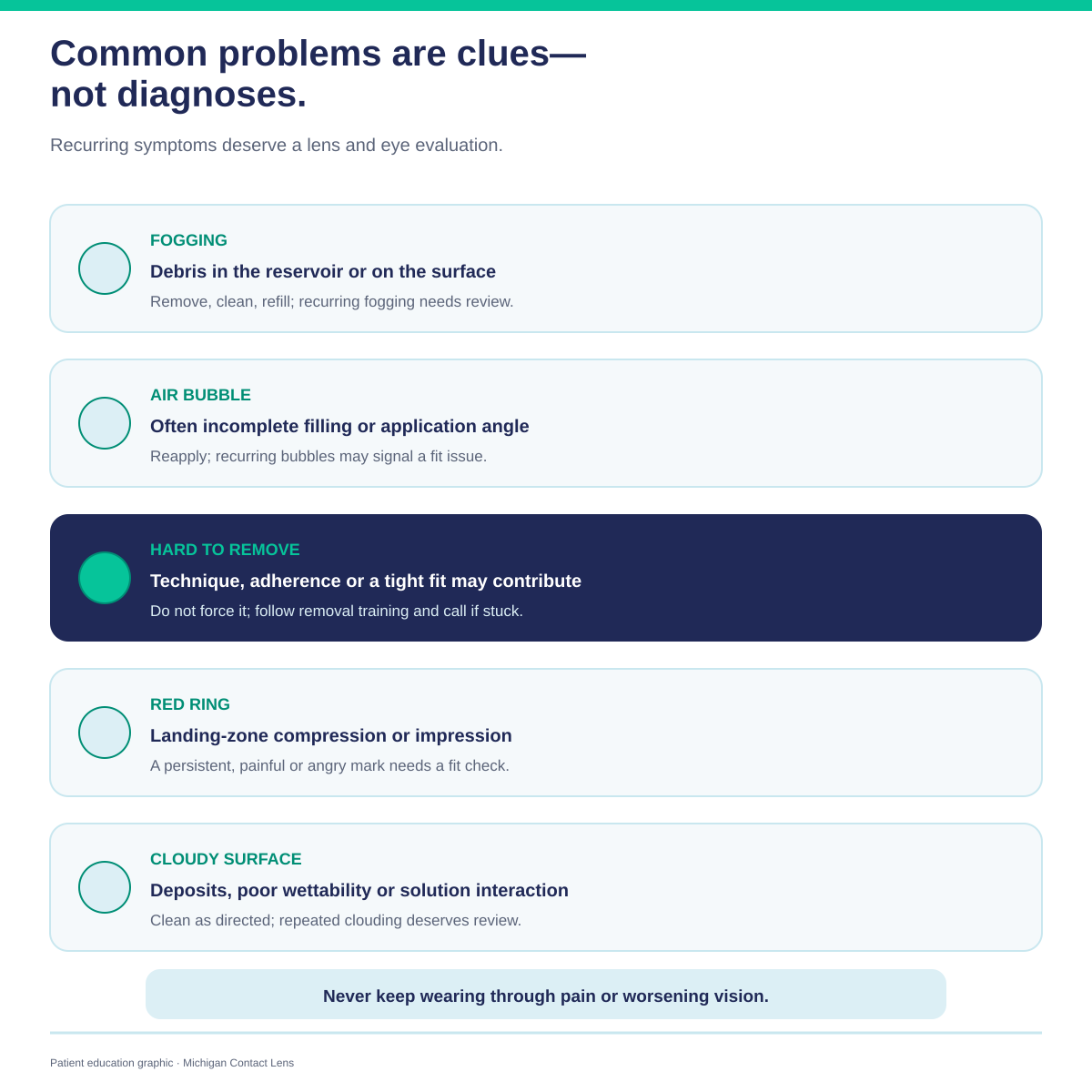
Do Scleral Lenses Hurt? Comfort And Adapting | MCL
A correctly fitted scleral lens should not hurt. What adaptation actually feels like, what discomfort usually turns out to be, and when to call.
Ready to see clearly again?
Michigan Contact Lens fits scleral and specialty lenses for keratoconus, irregular corneas, corneal transplants, and severe dry eye.