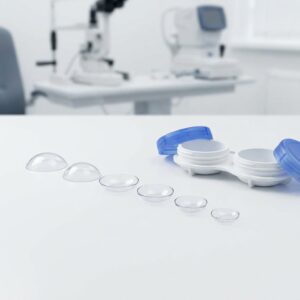
Hard contact lenses — specifically rigid gas permeable (RGP) lenses — are still one of the most effective treatments for keratoconus. Their firm, precisely shaped surface masks the cornea’s irregular cone, delivering sharp vision that glasses and soft lenses simply can’t. For many patients they’re the first specialty lens tried; for more advanced or hard-to-fit corneas, scleral lenses take over. This guide walks through how hard lenses work for keratoconus, the different types, what fitting and adaptation are really like, and how to know which lens is right for your eyes.
Why hard lenses work so well for keratoconus
Keratoconus distorts vision because the cornea — normally a smooth, dome-shaped window at the front of the eye — thins and bulges forward into an irregular cone. That irregular surface scatters light in every direction before it reaches the retina, which is why keratoconus causes ghosting, halos, streaking, and blur that glasses can never fully fix. As the cone steepens, a glasses prescription simply can’t keep up.
Soft lenses don’t solve the problem either, because they drape over the cornea and take on its irregular shape — so the distortion shows straight through them. A rigid lens does the opposite. It holds its own smooth, spherical shape and creates a brand-new, even optical surface in front of the eye. The tear film fills the microscopic gap between the back of the lens and the irregular cornea, optically “erasing” the cone. Light now focuses cleanly, and the improvement is often dramatic — many keratoconus patients describe their first well-fit rigid lens as the clearest vision they’ve had in years.
The types of “hard” lenses for keratoconus
“Hard lenses” for keratoconus actually come in several forms. The right one depends on the stage of your keratoconus, the shape and steepness of your cone, how sensitive your eyes are, and your lifestyle. A good specialty fitter chooses from the whole toolbox rather than forcing every eye into one design.
Corneal RGP (rigid gas permeable) lenses
These are the small, traditional gas permeable lenses that rest directly on the cornea. They offer outstanding, crisp optics and are a proven first option for mild-to-moderate keratoconus. Because they’re smaller and less expensive than sclerals, they’re often where a fitting begins. The trade-off is comfort and stability: on a steep or off-center cone, a corneal RGP can feel more lens-aware or shift with blinking, which is the usual reason patients eventually move to a larger design.
Scleral lenses
Scleral lenses are large-diameter rigid lenses that vault completely over the cornea and land on the white of the eye (the sclera), never touching the sensitive cone itself. A reservoir of sterile fluid sits between the lens and the cornea all day. That design makes them remarkably comfortable — often comfortable from the very first insertion — and ideal for advanced keratoconus, very steep or scarred cones, extremely sensitive eyes, or anyone a corneal RGP has failed. They’re the gold standard for hard-to-fit keratoconus, which is why so much of modern specialty practice centers on them.
Hybrid lenses
Hybrid lenses combine a rigid gas permeable center — for RGP-quality optics — with a soft outer skirt for comfort and stability. They’re a middle-ground option for patients who want the sharp vision of a rigid lens with easier adaptation and better centration than a small corneal RGP. Learn more about hybrid lenses for keratoconus and whether your cornea is a candidate.
Custom and specialty soft lenses
For very mild keratoconus, thick custom-designed soft lenses made specifically for irregular corneas can sometimes provide acceptable vision with maximum comfort. They rarely match the crispness of a rigid lens, but they’re worth knowing about as part of the full range of options.
RGP vs. scleral: which hard lens is right for you?
There’s no single “best” keratoconus lens — only the best lens for your cornea today. As a general guide:
- Early or moderate keratoconus, centered cone: a corneal RGP often delivers excellent vision at the lowest cost.
- Advanced, steep, decentered, or scarred cones: scleral lenses usually win on both vision and comfort.
- Sensitive eyes or dry eyes: sclerals bathe the cornea in fluid and avoid touching it, so they’re far more tolerable.
- Want rigid optics but easier adaptation: a hybrid can bridge the gap.
Many patients follow a natural path — starting with a corneal RGP and moving to a scleral lens as keratoconus progresses or if comfort becomes a problem. Switching isn’t a failure; it’s just matching the lens to the cornea as things change.
Signs your current lenses aren’t doing their job
Keratoconus is not a “fit once and forget” condition. It’s worth a specialty re-evaluation if you notice:
- Vision that has slipped even though your lenses haven’t changed
- Lenses that pop out, ride high, or shift constantly through the day
- Growing discomfort, redness, or the feeling that you “can’t wait to take them out”
- Being told elsewhere that “nothing more can be done” for your eyes
Any one of these is a signal that a different lens design — or a more precise fitting technology — could restore vision you thought was gone for good.
Are hard contact lenses uncomfortable?
This is the most common worry — and the reality is better than most people expect. Corneal RGP lenses do have an adaptation period: you’ll feel lens awareness for the first few days to a couple of weeks as your eyelids get used to the edge, and wearing time is built up gradually. Scleral lenses, by contrast, are often comfortable almost immediately, because they never touch the sensitive cornea and hold a cushion of fluid against the eye all day.
The single biggest factor in comfort is fit precision. A lens that’s even slightly off will always feel “off,” while a well-mapped, custom lens tends to disappear on the eye. That’s exactly why specialty keratoconus fitting is its own discipline — and why cookie-cutter fittings so often fail.
What keratoconus lens fitting looks like
Fitting a rigid lens to a keratoconic eye is nothing like grabbing an off-the-shelf soft lens. Here’s the typical process at a specialty practice:
- Corneal mapping. We create a precise 3D map of your eye’s surface — at Michigan Contact Lens with Eaglet Eye profilometry — so the lens is designed to your exact anatomy rather than an average.
- Diagnostic fitting. Trial lenses go on the eye so we can evaluate how the lens vaults, centers, and moves, and check your vision through it.
- Refinement. Parameters are adjusted — curvature, diameter, landing zone — until the fit and vision are dialed in.
- Custom order. Your lenses are manufactured to those exact specifications, usually arriving within a week or two.
- Training and follow-up. You’ll learn to insert, remove, and care for the lenses, and return for follow-ups — because keratoconus can change over time, and the fit should keep pace.
Caring for hard keratoconus lenses
Rigid and scleral lenses are durable and, cared for properly, can last one to a few years. Use only the cleaning and storage solutions your provider recommends, never rinse or store lenses in tap water, and fill sclerals with preservative-free saline before insertion. Good hygiene protects both the lens and the health of an already-vulnerable cornea, and it keeps your vision consistently crisp.
Lenses correct vision — cross-linking protects it
It’s important to understand what hard lenses do and don’t do. They deliver clear vision, but they don’t stop keratoconus from progressing. The treatment that slows or halts progression is corneal cross-linking, a procedure that strengthens the cornea’s collagen. For many patients the complete game plan is both: cross-linking to stabilize the cornea, and rigid or scleral lenses to see clearly. We co-manage cross-linking with corneal surgeons so the timing and sequencing are handled as a team.
Frequently asked questions
Are hard contact lenses better than soft lenses for keratoconus?
For keratoconus, yes. Soft lenses conform to the irregular cornea and can’t correct its distortion, while rigid (hard) lenses create a smooth new optical surface that dramatically sharpens vision. Soft or custom-soft lenses are usually reserved for very mild cases.
Do hard lenses stop keratoconus from getting worse?
No — lenses correct vision but don’t halt progression. The treatment that slows or stops progression is corneal cross-linking. Many patients do both: cross-linking to stabilize the cornea and rigid lenses for clear vision.
How long does it take to get used to hard contact lenses?
Corneal RGP lenses usually take a few days to two weeks of adaptation, with wearing time built up gradually. Scleral lenses are often comfortable almost immediately because they vault over the cornea and cushion the eye in fluid.
When should I switch from RGP to scleral lenses?
When a corneal RGP won’t stay centered, becomes uncomfortable, or can no longer correct an advancing cone, scleral lenses are usually the next step. Your specialist will recommend the switch based on your cornea’s shape and your comfort.
Can I still wear hard lenses after corneal cross-linking?
Yes. Cross-linking stabilizes the cornea but doesn’t restore its normal shape, so most patients still need a rigid or scleral lens for clear vision afterward. The lens is often refit once the cornea has settled following the procedure.
Struggling to get clear, comfortable vision with keratoconus? Dr. Shira Kresch fits the full range of rigid, scleral, and hybrid lenses for keratoconus patients across Metro Detroit at our Southfield office — your first specialty consultation is free. Book online or call (248) 545-2800.

|
FREE 58-PAGE GUIDE
The Scleral Lens Survival Guide
Fitting, troubleshooting, insertion and removal, supplies, and long-term care — everything we wish every patient knew on day one. Written by Dr. Shira Kresch and Dr. Melissa Barnett.
Get the free guide
|