The great majority of keratoconus can be managed without a corneal transplant. Modern care rests on two non-surgical pillars: specialty contact lenses to restore clear vision, and corneal cross-linking — a minimally invasive, in-office procedure — to stop the disease from getting worse. Surgery like a transplant is a last resort reserved for a small minority of advanced cases. Here’s how the non-surgical path actually works, and how to build a plan around your eyes.
Can keratoconus really be treated without surgery?
Yes — for most people. Keratoconus causes the cornea to thin and bulge into an irregular cone, which blurs and distorts vision. Two things need to happen: the progression needs to be slowed or stopped, and the distorted vision needs to be corrected. Neither of those requires cutting into or replacing the cornea in the vast majority of cases. With early detection and the right specialist, most patients keep their own cornea and see clearly for life. The key is not waiting until the disease is advanced.
The two goals of non-surgical care
Think of keratoconus treatment as two separate jobs that work together:
- Stop it from getting worse — this is the job of corneal cross-linking.
- See clearly again — this is the job of specialty contact lenses.
One doesn’t replace the other. Cross-linking stabilizes the cornea but doesn’t sharpen vision; lenses sharpen vision but don’t halt progression. Used together, they’re the complete non-surgical game plan.
Corneal cross-linking: stopping progression
Corneal cross-linking (CXL) is the only treatment proven to slow or halt the progression of keratoconus. It’s an in-office procedure — not an incisional surgery — that uses riboflavin (vitamin B2) drops activated by controlled UV light to create new bonds between the collagen fibers in the cornea. Those bonds stiffen and stabilize the cornea so the cone stops steepening.
Cross-linking works best when keratoconus is caught early and is still actively progressing — which is exactly why prompt diagnosis matters so much. It doesn’t reverse the cone or restore vision on its own; its value is preservation. We co-manage cross-linking with corneal surgeons and handle the specialty lens fitting before and after the procedure.
Specialty contact lenses: restoring clear vision
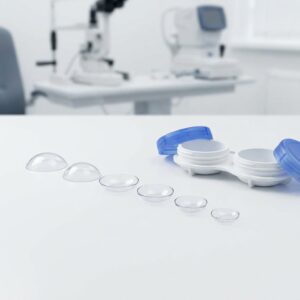
Because keratoconus makes the corneal surface irregular, glasses can only do so much — they can’t correct the distortion an uneven cornea creates. Specialty rigid lenses can, by replacing that rough surface with a smooth optical one. The main options:
- Scleral lenses — large rigid lenses that vault over the cornea and rest on the white of the eye, cushioned by fluid. The gold standard for moderate-to-advanced keratoconus and sensitive eyes.
- Rigid gas permeable (RGP) lenses — smaller corneal lenses with excellent optics, often a great first choice for milder cones.
- Hybrid lenses — a rigid center for sharp vision with a soft skirt for comfort.
The right lens is matched to the shape and stage of your cornea, mapped precisely with Eaglet Eye profilometry. For many patients, a well-fit scleral lens delivers the clearest, most comfortable vision they’ve had in years — no surgery involved.
Where glasses and soft lenses fit in
In very early keratoconus, glasses or standard soft lenses may still give acceptable vision, and there’s no reason to abandon them while they work. As the cone progresses, though, they stop keeping up — that’s the signal it’s time for specialty lenses. Custom-designed soft lenses for irregular corneas can bridge the gap for some mild cases, but rigid options remain the workhorses of keratoconus vision correction.
When is surgery actually needed?
Only a small minority of keratoconus patients ever need surgery. It’s considered when the cornea is too scarred, too steep, or too thin for a contact lens to provide functional vision. Even then, the options aren’t always a full transplant:
- Intacs (corneal ring segments) — tiny inserts that can flatten and regularize a cone in select cases.
- Corneal transplant (partial or full) — reserved for advanced disease with significant scarring, and often still followed by a scleral lens for the sharpest vision.
Because a scleral lens can restore vision through even a very irregular cornea, the right specialty fitting sometimes lets patients delay or avoid a transplant altogether.
Building your non-surgical plan
A strong non-surgical plan starts with precise diagnosis and monitoring — corneal mapping to see whether the cone is stable or progressing. If it’s progressing, cross-linking is discussed to lock in stability. Either way, a specialty lens fitting restores day-to-day vision, with follow-ups to keep the fit accurate as your eyes settle. It’s a partnership between you, your specialty lens practice, and (when needed) a corneal surgeon — with the shared goal of keeping your own cornea and your clear vision.
Frequently asked questions
Can keratoconus be treated without a corneal transplant?
Yes — the large majority of patients are managed without a transplant, using specialty contact lenses for vision and corneal cross-linking to stop progression. Transplants are reserved for a small number of advanced, heavily scarred cases.
Is corneal cross-linking considered surgery?
Cross-linking is a minimally invasive, in-office procedure, not an incisional surgery like a transplant. It uses riboflavin drops and UV light to strengthen the cornea and halt progression.
Will scleral lenses fix my keratoconus vision without surgery?
For most patients, yes. A scleral lens creates a smooth optical surface over the irregular cornea, often restoring sharp, comfortable vision — with no surgery. It corrects vision but doesn’t stop progression, which is cross-linking’s job.
Can I avoid surgery if my keratoconus is already advanced?
Often, yes. Because scleral lenses can correct vision through a very irregular cornea, many advanced patients still see well without a transplant. A specialty evaluation is the way to know your options.
Want to explore non-surgical options for your keratoconus? Dr. Shira Kresch builds personalized, lens-first treatment plans and co-manages cross-linking for patients across Metro Detroit at our Southfield office — your first specialty consultation is free. Book online or call (248) 545-2800.
|
FREE 58-PAGE GUIDE
The Scleral Lens Survival Guide
Fitting, troubleshooting, insertion and removal, supplies, and long-term care — everything we wish every patient knew on day one. Written by Dr. Shira Kresch and Dr. Melissa Barnett.
Get the free guide
|