
Keratoconus and Down Syndrome
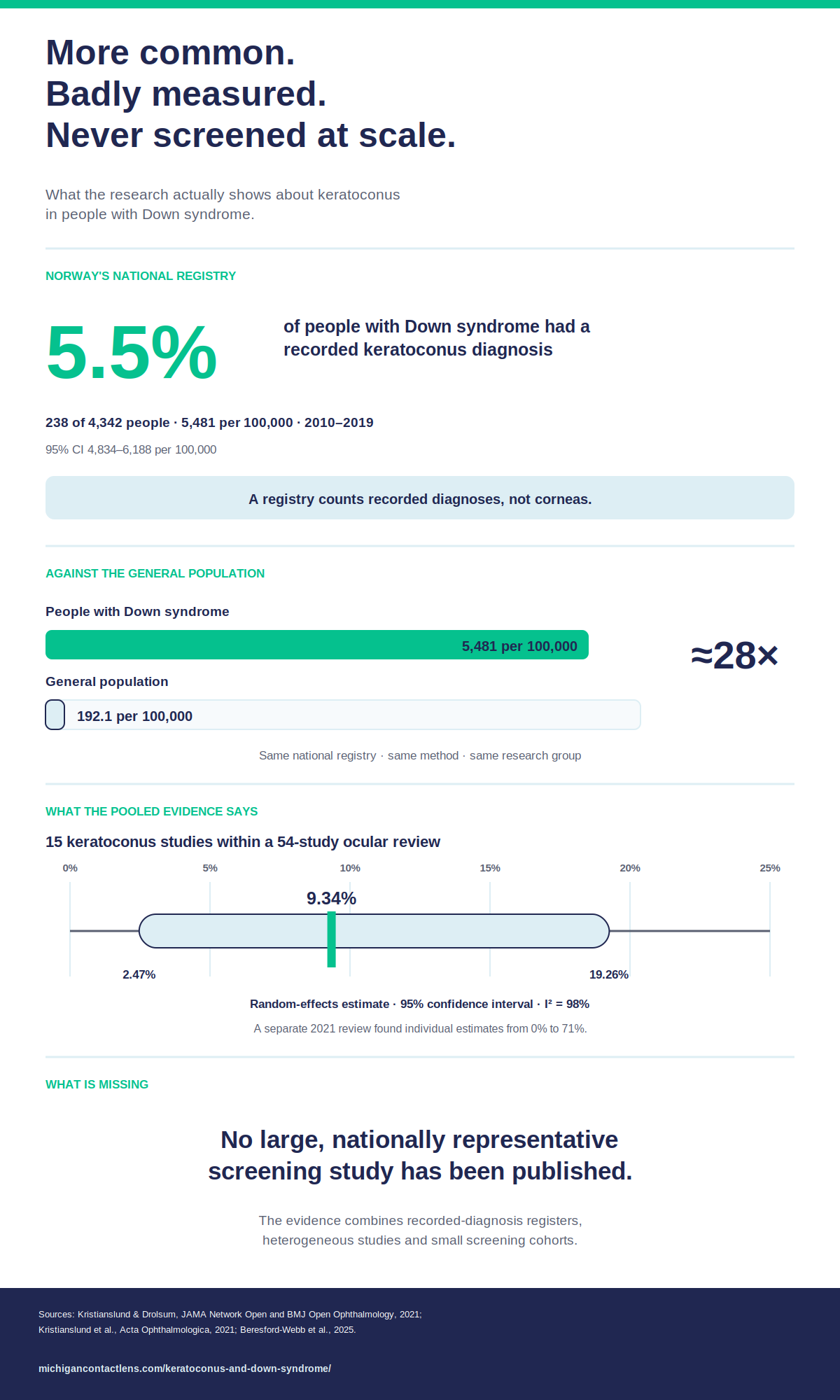
Keratoconus is substantially more common in people with Down syndrome than in the general population, but no one knows the true rate. Norway’s national registry recorded a diagnosis in 5.5% of 4,342 people — about 28 times the rate recorded for the general Norwegian population. A 2025 meta-analysis pooled 15 studies to 9.34%, with a confidence interval running from 2.47% to 19.26%. Individual studies report anywhere from 0% to 71%. Small tomography studies have reported higher proportions than the Norwegian registry. No large, nationally representative screening study has yet been published.
Every figure on this page was read in the journal article cited, not in a press summary or another website’s citation. Where a number could not be traced to its source, we say so. This page is a companion to our main reference, 57 Keratoconus Statistics for 2026, which covers prevalence, risk factors, progression, cross-linking and lens outcomes in the general population.
Why this matters. Corneal cross-linking can slow or halt the progression of keratoconus, particularly when the condition is detected early. It does not reverse corneal scarring that has already formed. In a group where the condition is roughly an order of magnitude more common, and where a child may not be able to describe gradually blurring vision, the argument for looking rather than waiting for a complaint is a strong one.
What the evidence shows
01Norway’s national registry recorded keratoconus in 5.5% of people with Down syndrome.
This is the strongest nationwide recorded-diagnosis estimate available. It captured everyone with the relevant diagnosis codes registered through Norway’s publicly funded specialist care over a ten-year period, which largely removes the selection problem that distorts small hospital samples — where the people who attend tend to be the ones already having trouble.
What it is not is population screening. Nobody scanned 4,342 corneas. The registry counted diagnoses that clinicians had already made and coded, which means the figure depends on how many people were referred, examined and correctly coded in the first place.
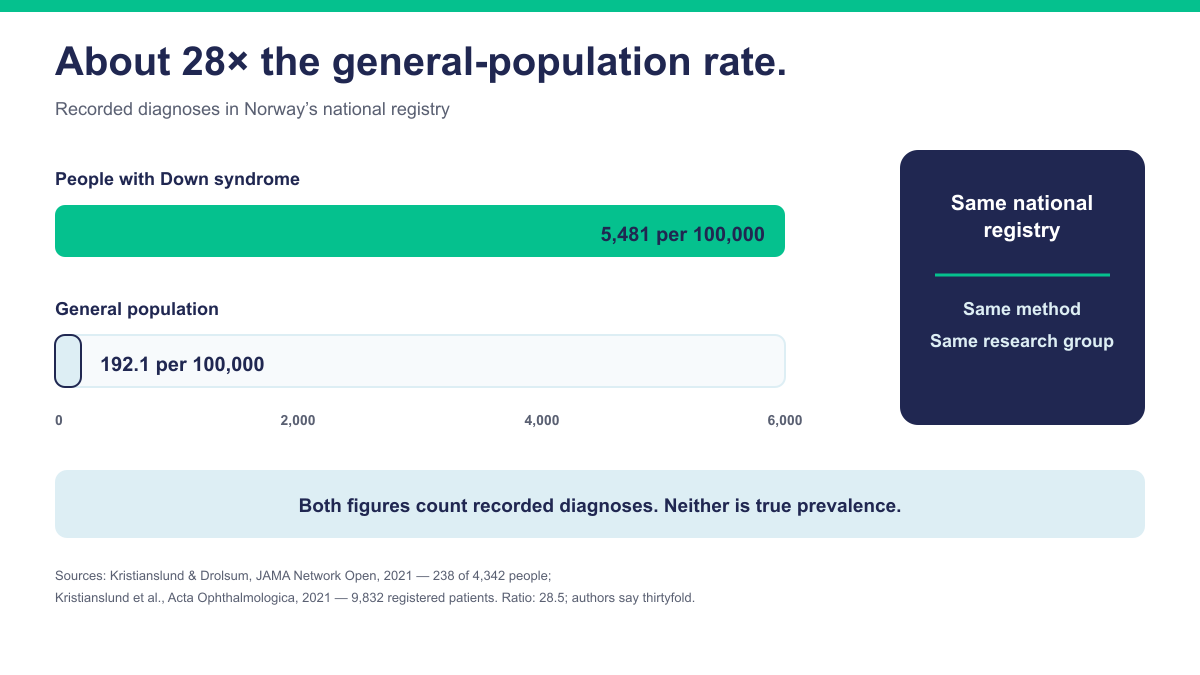
02That is about 28 times the rate recorded for the general Norwegian population.
This comparison is cleaner than most in the literature. The general-population figure comes from the same national registry, assembled by the same research group using the same method, so it avoids the usual mismatch of setting a registry count against a screening study. Both sides count people with a recorded diagnosis, and both are subject to the same registration limitations.
03Across 20 studies, reported estimates ranged from 0% to 71%.
The problem that makes general keratoconus prevalence figures disagree by a factor of fifty is worse here. The studies differ in who they recruited, how many, at what age, and how they defined the disease — and the review’s authors rated the quality of evidence as low throughout. An estimate quoted from this literature without its study design attached tells you very little.
The overall body of evidence points toward elevated risk, but individual findings vary substantially, and several studies reported no cases at all. Most studies that included adults reported high prevalence, and in many of those the estimate exceeded ten times the general-population rate.
Both ends of that range are worth understanding rather than quoting. The 2025 meta-analysis attributes the 71% figure to the only study in it that used advanced corneal topography, and identifies that same study as a statistical outlier. Its authors also observe that older studies using less sensitive diagnostic tools may underestimate how often keratoconus occurs in this group. So the highest number in the literature came from the most sensitive method available — and was set aside for being extreme. At the other end, the studies reporting no cases came predominantly from East Asia.
04The newest meta-analysis pools 15 studies to 9.34% — and one paper moves that figure by a third.
This is the most recent quantitative synthesis, and it is the closest thing to a single headline figure that exists. It should still not be quoted as the prevalence, for two reasons that the authors themselves report.
First, the heterogeneity is extreme. I² = 98% means almost all the variation between the pooled studies reflects real differences between them rather than chance, and the confidence interval — 2.47% to 19.26% — is nearly eightfold wide.
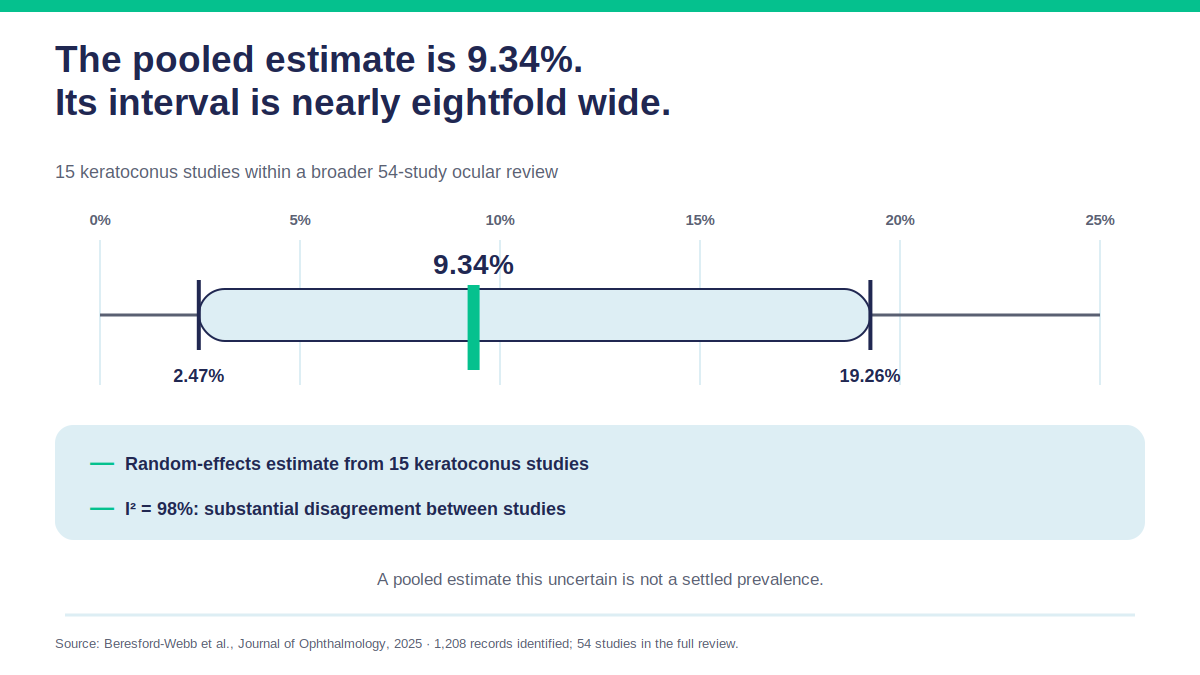
Second, the estimate is not robust. The authors’ own sensitivity analysis found that removing a single study dropped the pooled figure from 9.34% to 6.04%. Of all the ocular conditions in that review, keratoconus was the only one where one study moved the result. A pooled number that shifts by a third when you remove one paper is a summary of a disagreement, not a measurement of a population.
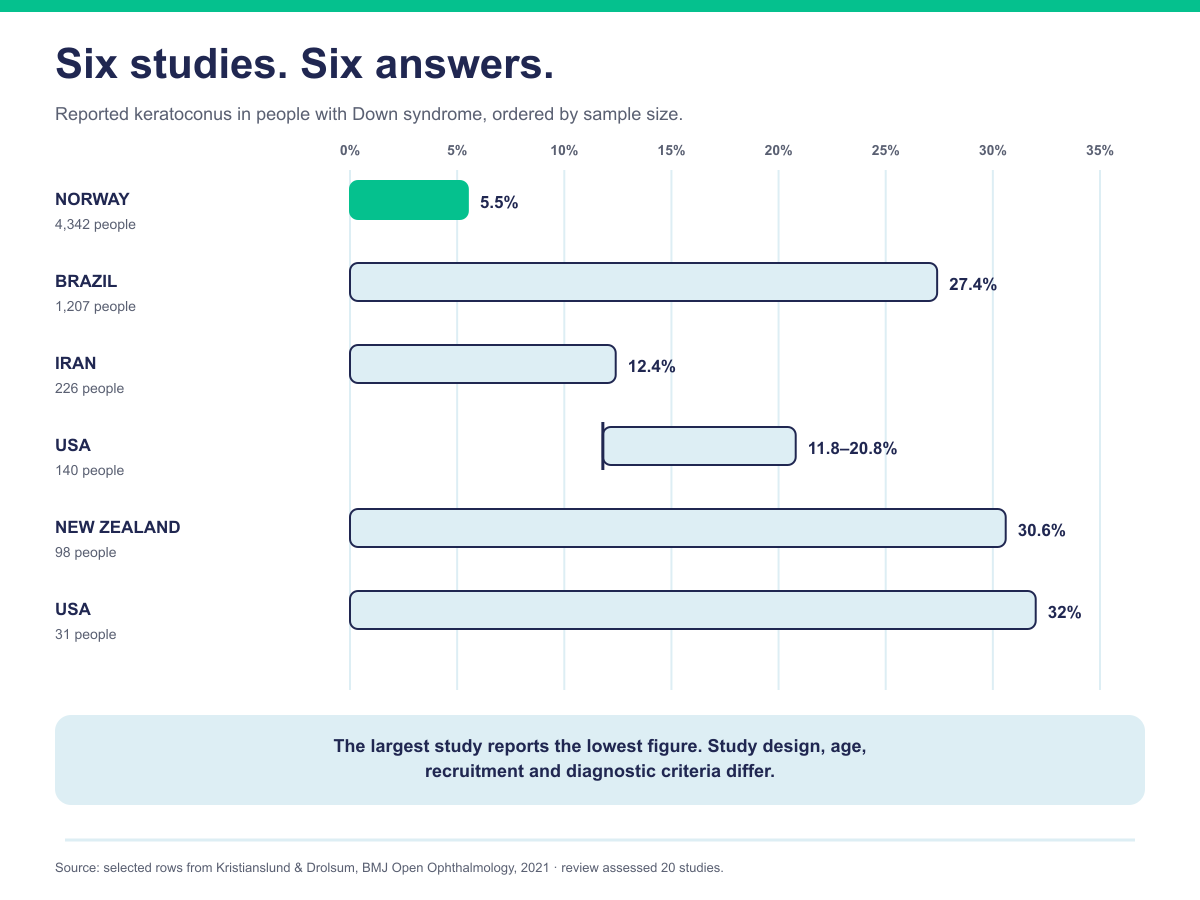
05The individual studies, as the 2021 review records them.
Below is that review’s own extraction table for the larger studies it assessed. These figures are reported as the review recorded them, not read by us in each original paper — which is why they appear as a table rather than as separate verified statistics. The spread is the point: every one of these is a real study, and they do not agree.
| Study | Country | N | Found | Design and age |
|---|---|---|---|---|
| Kristianslund & Drolsum | Norway | 4,342 | 238 (5.5%) | Population-based register study |
| Bermudez et al. | Brazil | 1,207 | 331 (27.4%) | Retrospective medical records review, adults |
| Hashemi et al. | Iran | 226 | 28 (12.4%) | Population-based cohort, age 10–30 |
| Marsack et al. | USA | 140 | 11.8%–20.8% | Case-control, age 8–55 (26–46 eyes) |
| Mathan et al. | New Zealand | 98 | 30 (30.6%) | Screening of Paralympic athletes, age 15–53 |
| Imbornoni et al. | USA | 31 | 10 (32%) | Children and young adults in hospital, age 4–24 |
06One tomography cohort of 226 people aged 10 to 30 found keratoconus in 12.4%.
This study imaged every participant rather than counting existing diagnoses, which makes it a different kind of evidence from the registry figures. It reported a higher proportion than the Norwegian registry — but the two are not directly comparable, and the difference cannot be attributed to imaging alone. The countries differ, the age ranges differ, the recruitment differs, and the diagnostic criteria differ.
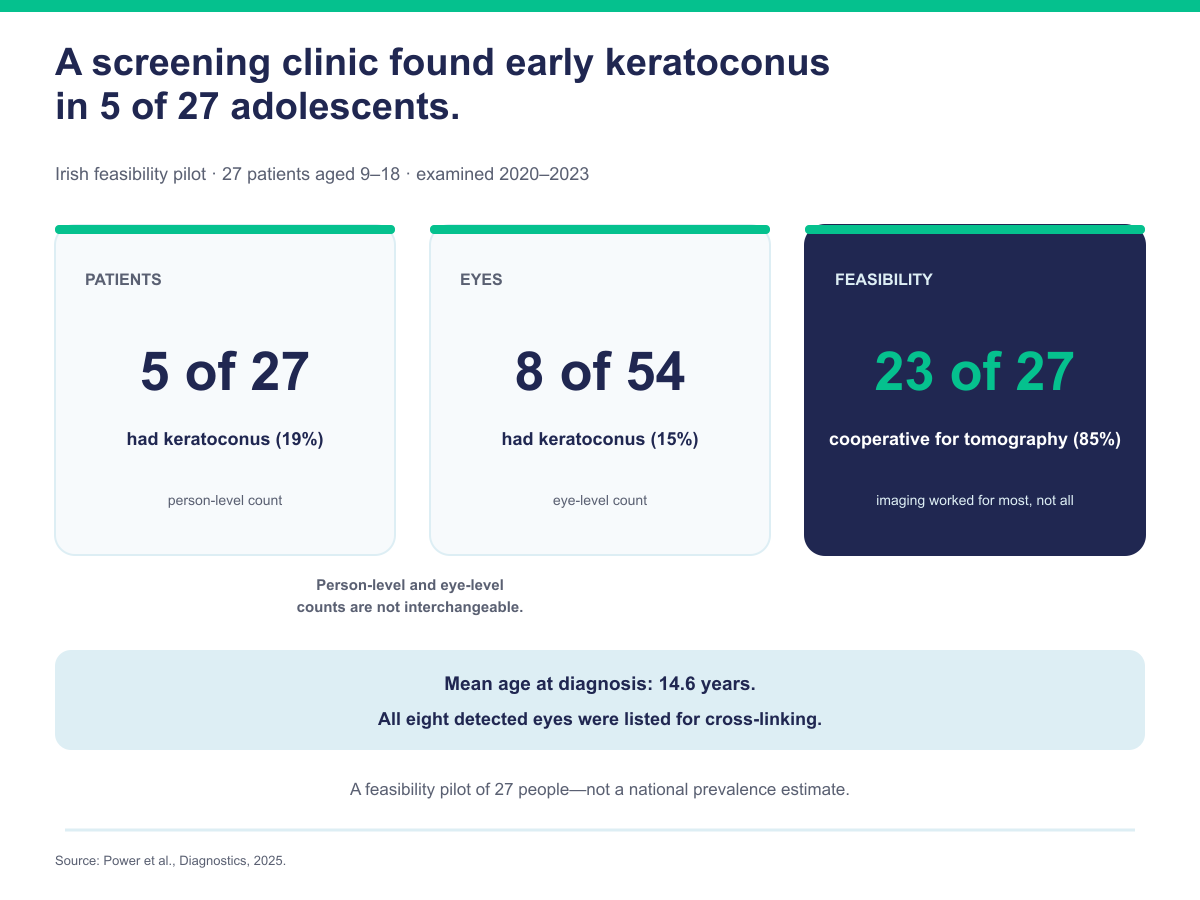
07An Irish pilot screening clinic found treatable keratoconus in 5 of 27 adolescents.
This is the closest thing to a screening programme yet published in this population, and it was explicitly a feasibility pilot rather than a prevalence study. Twenty-seven is far too few to estimate a national rate. What it does demonstrate is that tomographic screening in a clinic setting finds early, treatable disease in adolescents who had not been referred for it.
Note the two denominators, which the paper’s own abstract runs together. Eight of 54 eyes is 14.8%. Five of 27 patients is 18.5%, which the paper rounds to 19%. These are different measurements and should not be quoted interchangeably.
08In that pilot, corneas were thinner and steeper than the comparison group.
This is a measurement rather than a diagnosis, and it points at why screening this group is worth doing. Thinner, steeper corneas are the structural pattern in which keratoconus develops. It does not follow that everyone with these measurements will develop the disease.
The comparison deserves a caveat the headline figures do not carry. The control data were drawn from published literature rather than recruited alongside, and that comparison group had high baseline astigmatism — which was presumably why they had been scanned in the first place. That makes them an imperfect stand-in for a healthy population, though if anything it makes the difference found here a conservative one.
09In a randomised trial followed to three years, cross-linking halted progression in most eyes — but not all.
This is the study that makes screening worth doing, and it is also the one that stops us saying cross-linking “stops” keratoconus. Twenty-seven young people with Down syndrome and progressive keratoconus in both eyes had one eye randomised to each of two protocols, under general anaesthesia. Across two and three years, neither group’s corneal steepening changed significantly, which is the outcome you want.
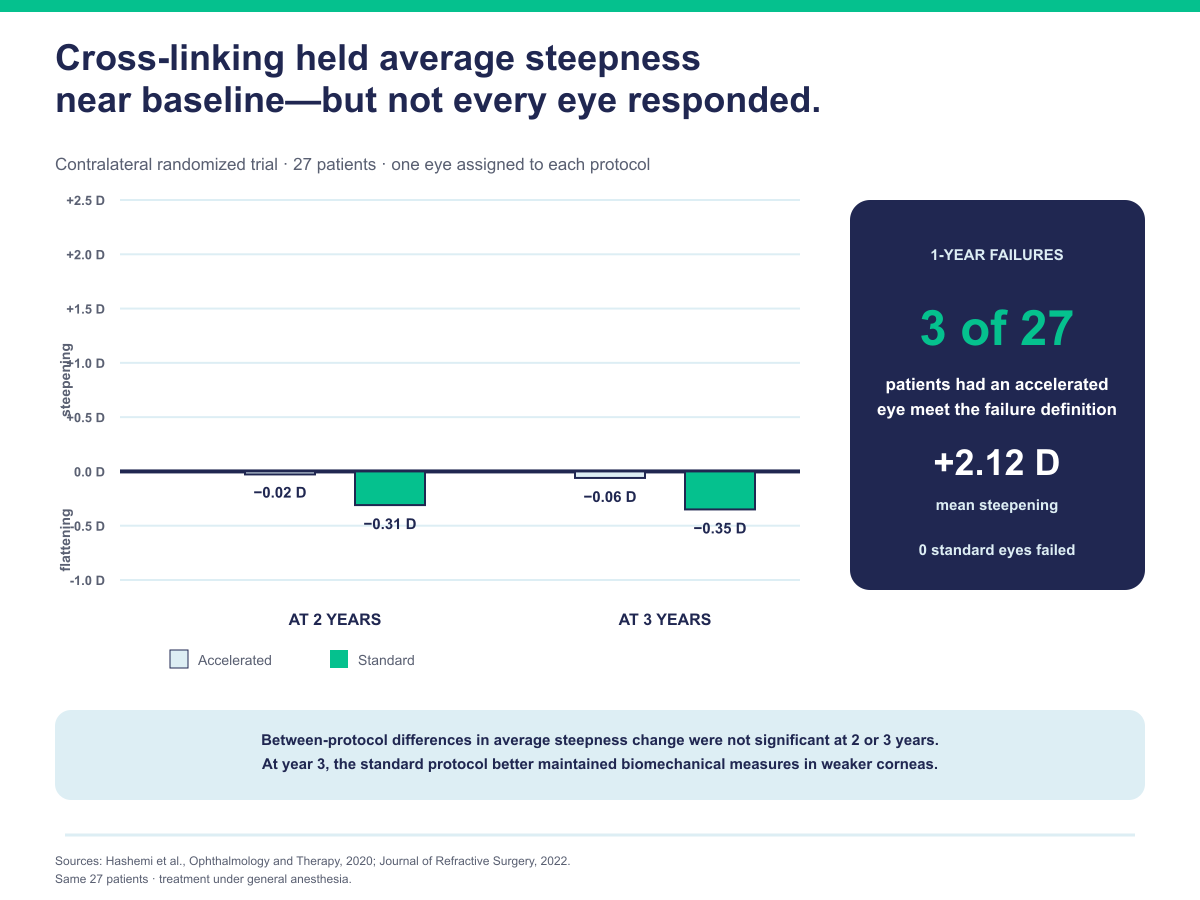
Two caveats survive that result. Three patients in the accelerated group met the trial’s definition of treatment failure at one year, with steepening of more than 2 dioptres; by two years those eyes had settled back slightly. And at three years, the standard protocol held the cornea’s biomechanical properties better than the accelerated one. Cross-linking is effective and worth doing early. It is not a guarantee, and it needs follow-up.
10No large, nationally representative screening study has yet been published.
Tomographic screening has been done in this population, in the cohorts above. What has not been done is a large, nationally representative screening study. In the general population, estimates rose substantially as tomography, broader sampling and changing diagnostic definitions came together — no single one of those explains the shift on its own. The equivalent work has not been carried out here.
Until it is, the honest answer to “how common is keratoconus in Down syndrome” is a range with a method attached, not a number.
What follows from this, and what does not
It follows that the risk is substantially elevated. Taken together, the evidence supports a markedly higher rate in people with Down syndrome, particularly in adult-inclusive and registry studies. Individual estimates nevertheless range from 0% to 71%, so not every single study found an elevated rate.
It follows that registry counts probably miss cases. The Norwegian authors suspected undiagnosed cases, and the tomography studies find disease in people who had not been referred. How many are missed is unknown.
It does not follow that the true prevalence is above 5.5%. A 12.4% figure from an Iranian cohort aged 10 to 30 cannot establish Norway’s national prevalence. Current evidence cannot tell us whether the true figure is above 5.5%, or by how much.
It does not follow that every estimate here is a minimum. Registry diagnosis counts likely miss undiagnosed cases. Screening-study estimates are specific to their samples and may be above or below a national rate, depending on recruitment, criteria and chance.
It does not follow that any single percentage should be quoted as the rate. The pooled meta-analytic figure carries an interval from 2.47% to 19.26%, and drops to 6.04% if one study is removed. If a patient leaflet needs one number, the Norwegian registry figure is the best-supported nationwide estimate, and it should be given as a recorded-diagnosis rate with its method attached.
What screening actually involves
The test that matters is corneal tomography — a scan, taking seconds per eye, that maps the shape and thickness of the cornea. It is not the same as a standard sight test, and a normal glasses prescription does not rule keratoconus out. Early keratoconus is often asymmetric, so the better eye compensates and vision can feel unremarkable.
Two practical points come out of the published work. The Irish pilot found a mean age at diagnosis of 14.6 and its authors advocate tomographic screening in the mid-teens. And the cross-linking trial enrolled patients aged 10 to 19, which is the window in which progressive disease is typically caught and treated.
Cooperation with tomography varies, and the published experience is honest about it. The Irish pilot reported that 23 of its 27 participants, or 85%, were cooperative for Pentacam imaging — so it was feasible for most, but not all. The same paper notes that visual acuity data were limited by differing levels of intellectual disability. In practice this means allowing more time, more than one attempt, and a familiar adult present. Where cross-linking treatment was needed in the randomised trial, it was carried out under general anaesthesia.
On screening recommendations. The authors of the review and of the Irish pilot both conclude that keratoconus screening in people with Down syndrome should be considered, on the grounds that cross-linking can halt progression when disease is found early. Those are their recommendations, reported here as they made them. Whether and when to screen a particular person is a clinical decision for the treating practitioner.
What is still unknown
- The true prevalence. No large, nationally representative screening study exists. Every figure above is a recorded-diagnosis count, a small-sample estimate, or a pooled summary of both.
- How much registries undercount. The direction is probably downward, but registration accuracy introduces error in both directions and the size of the gap has not been measured.
- Whether prevalence genuinely differs by region or ancestry. The 2025 meta-analysis reports 0% in studies from East Asia, 6.59% in Europe and North America, and 25.45% elsewhere, and suggests age and ethnicity may matter. Those studies also differ in method and diagnostic sensitivity, so the pattern cannot yet be read as a purely biological finding.
- Long-term cross-linking outcomes in this group. Published follow-up extends to three years in the same 27 patients. No larger randomised trial has been published.
- Optimal screening age and interval. The mid-teens recommendation rests on a 27-person pilot. It is a reasonable starting point, not an established protocol.
How we verified this page
Each figure was read in the article cited. The two Norwegian studies, the 2021 review, the Irish pilot and the 2025 meta-analysis were read in full text. The Iranian cohort and the cross-linking trial were verified against their published abstracts, which report the figures used here. The extraction table in statistic 05 is attributed to the review, because that is where we read it — we have not obtained each of those original papers, and we say so rather than implying otherwise.
Arithmetic was reconciled rather than assumed. 238 of 4,342 is 5.4813%, matching the reported 5.5% and 5,481 per 100,000. 28 of 226 is 12.389%, matching the reported 12.39%. 8 of 54 eyes is 14.8% and 5 of 27 patients is 18.5%, which is why both denominators appear separately above. One figure did not reconcile: 331 of 1,207 is 27.4%, where the review’s table prints 27.2%. We show the arithmetic and flag the difference.
Where our arithmetic and an author’s wording differ, we say so on the page rather than silently picking one. The ratio of 5,481 to 192.1 is 28.5; the authors describe it as thirtyfold. Both appear above.
This page has been through three rounds of external fact-checking since publication. The first found several places where a reasonable interpretation had been written as a certainty. The second caught a claim about tomography cooperation that we had inferred rather than sourced, and identified three papers we had missed. The third caught a genuine error: we had described the pooled meta-analytic estimate as drawn from 54 studies, when 54 was the study count for the whole ocular review and the keratoconus estimate pooled 15. That has been corrected, and reading the paper in full to fix it surfaced the sensitivity analysis and the regional breakdown now reported above.
If you believe a figure here is wrong, we want to know.
Reuse this page
Free to reuse, including commercially. Everything on this page, including every chart, may be reproduced in articles, reports, presentations and teaching material under a Creative Commons Attribution 4.0 licence, provided you credit Michigan Contact Lens and link back. You do not need to ask first.
Every figure last checked against its source: 4 August 2026. Revision history: 4 August 2026 — first publication. 4 August 2026 — revised after external fact-check; interpretive statements tightened, three studies added. 4 August 2026 — second fact-check; tomography cooperation figure corrected, 2025 meta-analysis and three-year cross-linking follow-up added, Bermudez arithmetic discrepancy flagged. 4 August 2026 — third fact-check; pooled estimate corrected from 54 studies to 15, heterogeneity, sensitivity analysis and regional breakdown added. 4 August 2026 — charts added.
Specialty lenses for irregular corneas
Michigan Contact Lens is a specialty contact lens practice in Southfield, Michigan. We fit scleral lenses and other custom lenses for keratoconus and irregular corneas, including for patients who find standard lenses difficult to manage, and we see patients referred by optometrists and ophthalmologists across the state. If you are looking for a keratoconus specialist in Michigan, or you would like to discuss screening for a family member, our new patient information explains what a first visit involves.
To book or ask a question, contact us or call 248-545-2800.
Related reading

57 Keratoconus Statistics For 2026 (Every Figure Verified At Source)
57 keratoconus statistics on prevalence, risk factors, progression, cross-linking and lens outcomes — every number checked in the cited source, explained in plain language, with a link to each one.

Scleral Lens Brands: A Guide To The Options
A guide to scleral lens brands and designs — diagnostic, profilometry-designed, and custom-molded — and why the fit matters far more than the brand you choose.

Multifocal Scleral Lenses: Clear Vision At Every Distance
Multifocal scleral lenses correct an irregular cornea or dry eye and presbyopia at once — clear near, intermediate, and distance vision in one custom lens.

Autologous Serum Eye Drops For Severe Dry Eye
Autologous serum eye drops are made from your own blood serum for severe dry eye — Sjögren's, GVHD, neurotrophic disease.

Best Eye Drops For Sjogren's Dry Eye: A Guide
The best eye drops for Sjögren's dry eye: preservative-free tears, prescription anti-inflammatories, serum tears — and why severe cases need more than drops.

Aphakia: Causes, Symptoms & Contact Lens Options
Aphakia is the absence of the eye's natural lens, causing extreme farsightedness. Causes, symptoms, and how glasses, contact lenses
Ready to see clearly again?
Michigan Contact Lens fits scleral and specialty lenses for keratoconus, irregular corneas, corneal transplants, and severe dry eye.